
Separating cells without alteration
Since 2014, pluriSelect Life Science has been developing instrument-free separation technologies that isolate cells without complex equipment and with minimal methodological influence. leap:up is supporting the company's organisational and strategic development.
Before cells can be analysed, they must be isolated from complex samples. However, many established methods influence the cells so significantly through mechanical, chemical or magnetic stress that subsequent results can no longer be clearly attributed to biological causes. Methods such as FACS (fluorescence-assisted cell sorting) and MACS (magnetic cell separation) are considered precise methods, but they require large specialised equipment and trained personnel, and therefore incur high investment and maintenance costs. For many laboratories, this expense is only feasible to a limited extent. Classic density gradient methods also involve shear forces or chemical influences that have been shown to affect sensitive surface structures. Particularly when addressing subtle cellular differences or functional characteristics, this makes it difficult to distinguish biological variability from method-related changes. This recurring challenge prompted pluriSelect Life Science GmbH in Leipzig to develop alternative, less stressful separation approaches.
An independent approach to separation
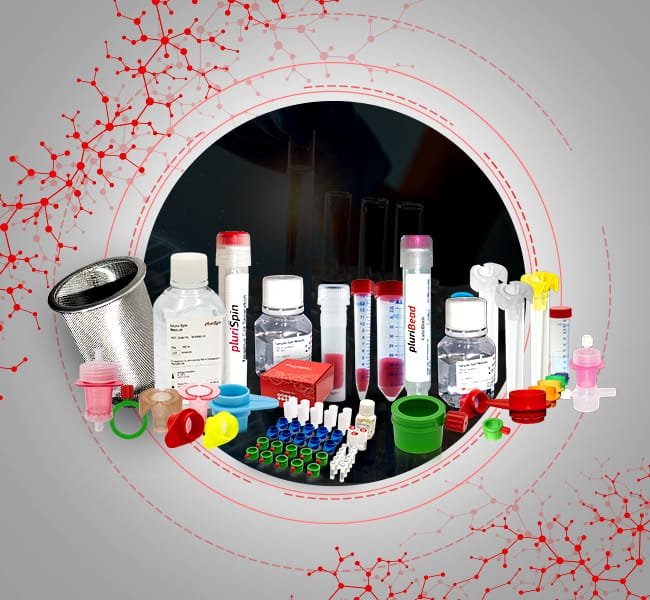
pluriSelect was founded in 2014 with the aim of developing separation technologies that do not require specialised equipment and enable defined, reproducible separation steps. Their pluriBeads® technology uses polymer-based microparticles with functionalised surfaces for the selective binding of specific cell populations. Separation is achieved through controlled washing steps, without external magnetic fields or optical systems. This results in significantly lower method-related cell stress, which is particularly relevant for functional assays and single-cell analyses. With pluriSpin®, the company has developed a process that separates cell fractions by size and density without using toxic gradient materials and without generating centrifugation-induced shear forces. The pluriStrainer® technology comprises colour-coded filter screens in 18 mesh sizes from 5 µm to 1,000 µm. This makes pluriSelect the only company worldwide to cover a range far beyond the usual standard sizes of 40, 70 and 100 µm. The filters complement the overall system with defined mechanical filtration via standardised mesh fabrics and form a reliable basis for homogeneous sample preparation.
Together, these three technologies form a modular system that enables robust and low-stress separation steps without laboratories having to invest in extensive technical infrastructure. The processes are suitable for both basic research environments and specialised laboratory areas where reproducible cell quality is a prerequisite for subsequent analysis or production processes.
A market between high-end systems and basic technology
pluriSelect's processes operate in a market dominated by large, device-based systems such as FACS, MACS or microfluidic sorters. These enable high-resolution separation, but require considerable investment, maintenance and infrastructure. At the other end of the spectrum are simple filtration aids, which are limited in their standardisation.
pluriSelect occupies the clearly defined middle ground: a defined separation approach that is not dependent on equipment, but with controllable physical and biochemical properties. The processes are therefore just as suitable for laboratories with limited technical equipment as they are for environments that require complementary, less invasive process steps. With the increasing establishment of microfluidic and multimodal analysis systems, the importance of upstream cell material that is as unadulterated as possible is growing. Low-stress separations may also play an increasing role in future clinical scenarios, such as in diagnostics or in the early stages of cell therapy development.
The development of pluriSelect initially proceeded with a small team and limited resources. The technological platforms were expanded and refined over several years, while parallel supply chains, quality standards and production capacities were developed. Financing was mainly organic, based on product sales and project-related support, supplemented by gradual international scaling. Current development processes include the ongoing certification process in accordance with DIN 13485 and the complete conversion of all plastic products to 100 per cent bio-based materials by the end of 2027. In addition, pluriSelect is working on integrating its own separation technologies into automated laboratory stations in the long term and preparing them for GMP-compatible workflows so that they can also be used in regulated production and diagnostic environments in the future. Integration into microfluidic platforms is also being investigated, particularly with regard to preparatory steps that provide defined fractions for downstream analyses.
With the further development of separation technologies, organisational issues have become more prominent at pluriSelect: robust quality management processes, preparation for regulated markets, a clear separation of research and production, and the establishment of stable delivery and documentation structures. This also includes clear responsibilities, prioritised development processes and scalable procedures. The collaboration with leap:up is about structuring development and production steps in such a way that they comply with the requirements of DIN 13485 and, in the future, GMP-compatible workflows. This includes the design of internal roles, the documentation of central processes and decision-making processes, and the planning of growth steps in line with existing resources. leap:up also supports the company's development by providing an environment that facilitates cooperation, knowledge transfer and access to partners along the regional value chain. This integration is important for pluriSelect, as its technologies are increasingly being used in diagnostic and industrial contexts, creating new requirements for exchange and networking.